
Kasinomics Unleashed: The Evolution of the Informal Economy and the Inspiring Entrepreneurs and Executives who Power it
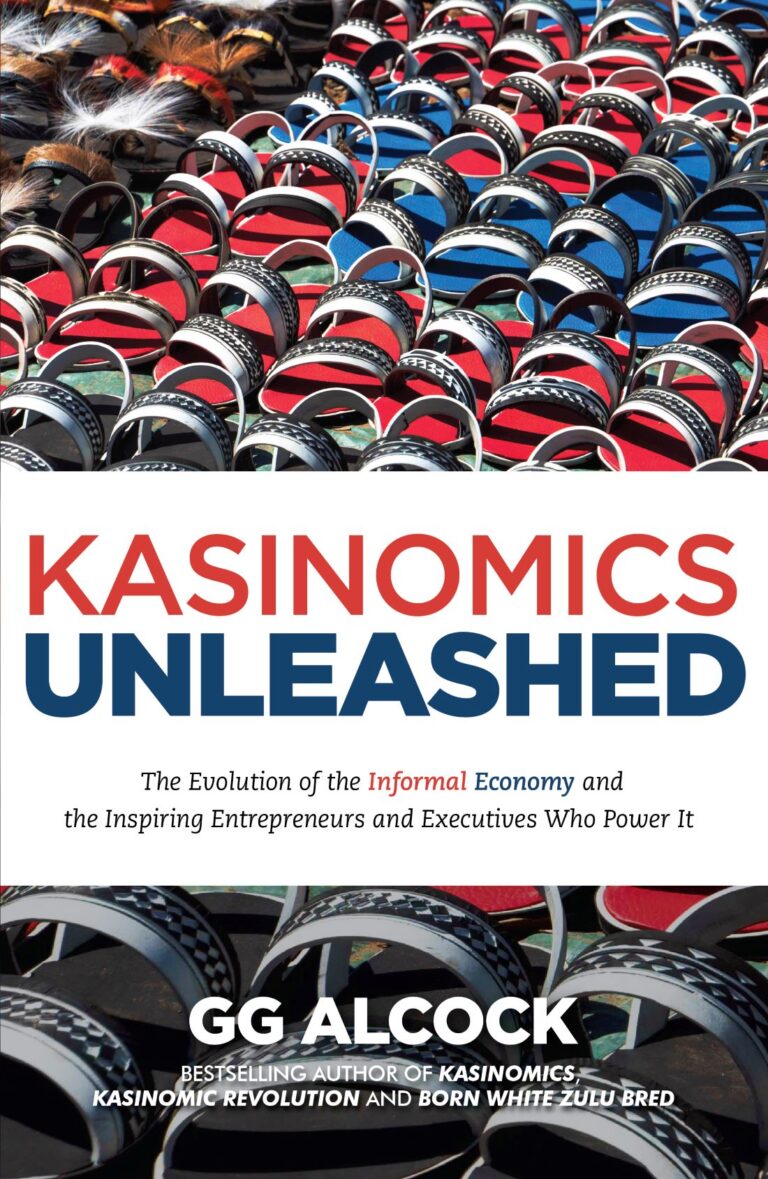 GG Alcock, Kasinomics Unleashed: The Evolution of the Informal Economy and the Inspiring Entrepreneurs and Executives who Power it (Johannesburg: Tracey McDonald Publishers, 2025)
SOUTH Africa has an unemployment rate of well over 30% and is the most unequal country in the world. Such is the generally accepted wisdom. Observation suggests this may not be so; nor has the country had a reliable census for at least fifteen years. And above all there is the informal sector about which GG Alcock writes in such an entertaining and informative way (although he could use a good editor and a proofreader).
Alcock argues that this often-invisible economy should rather be seen as an independent business sector. It has grown seven times since 1994 and shown an enormous ability to adapt, innovate and thrive in a rapidly expanding mass market. A reflection of the formal economy, it is a ‘multi-sectoral ecosystem that mirrors every formal sector … beyond the reach of traditional metrics.’ In other words, minimal paperwork, few overheads and little for the taxman. Much of this involves food sales, services, rented accommodation and above all, the taxi industry. This parallel economy could be worth at least R750 billion annually.
People are recorded as job seekers in the formal economy, but this does not necessarily mean they have no work or income. Mirriam, the woman selling vetkoek and fish, can make R1,500 profit per day and is a successful businessperson; a kasipreneur in Alcock’s estimation, not unemployed. So, what is the actual rate of unemployment in South Africa? Some observers believe it to be as low as 10%. The absence of a payslip equates to unemployment; but people are not necessarily poor. And the definition of a ‘proper’ job needs radical revision: one of Alcock’s examples makes a decent living cleaning dustbins and earning regular income.
Small starts, very hard work and community connections have often been the key to success, but limited access to credit and marketing opportunities tend to impose a ceiling. Many kasipreneurs are content with this. Capitec has discovered that three million of its customers use their personal bank accounts for business purposes. The use of social grants as capital is widespread while stokvels have been a pillar of the social and economic structure for many decades. There is a detailed account in this book of the township and rural construction industry with widespread upscaling of property and ingenious ways of acquiring materials. The amaroomi phenomenon has become a lifestyle choice in townships. Delivery services and Internet cafes are other areas of growth.
Msinga, where Alcock grew up, is regarded as one of the poorest districts of South Africa. But even here there is development given that a quarter of the burgeoning African middle class lives in rural areas and black tax and migrant remittances make a major contribution. In the deeper rural areas, goat farming sustained by protein food blocks has great potential and the Alcock family enterprise at Mdukatshani organises barefoot vets through a livestock support programme. (Apartheid leaves a footprint of irony. Msinga has two towns: Tugela Ferry and Weenen. Africans were forcibly removed from the latter, which is now dying, while the former is a thriving frontier town.)
Cash is king in the invisible economy, although transactions are beginning to be digitised. Alcock foresees hybrid modes of operation using WhatsApp and ipini on the most basic, cheap devices avoiding data-hungry apps.
The writer addresses the thorny issue of tax, which is far from straightforward. Informal traders pay VAT on supplies, but do not reclaim because they are unregistered; in part because SARS makes registration so difficult. Fifteen million commuter journeys take place every working day using 250,000 taxis and the petrol they consume is subject to the general fuel levy. Complexities of communal land tenure and RDP housing do mean, however, that millions of houses lack valuations and pay no rates; but this is a failure of government. Alcock has discussed the possibility of a turnover tax with SARS, which lacks the imagination to come up with a simple model. The conclusion is that people are not evading tax but lack time and means to comply.
Forty years ago, the University of Natal economist Norman Bromberger in the context of a debate about whether the national economy was single or dual, collaborative or exploitative looked in detail at how South Africans in rural areas survived. His conclusion was that they had a resilient and innovative approach that was more sophisticated than realised.
Alcock now confirms this, but is he being overoptimistic? Corporates increasingly appreciate the opportunities presented by the informal economy. Some have even walked the township streets gaining insights rather than sticking with boardroom assumptions. The result has been reciprocity between sectors – izandla ziyagezana (hands wash each other). Alcock reckons this to be more promising than black economic empowerment. Indeed, it sounds more in tune with qualities like perseverance, resilience, ingenuity and basic courage that he records in this book; and in accord with a need for job creation to be organic.
Book review by Christopher Merrett, reproduced from his web page, From the Thornveld