
Belonging: A History of Indian South Africans
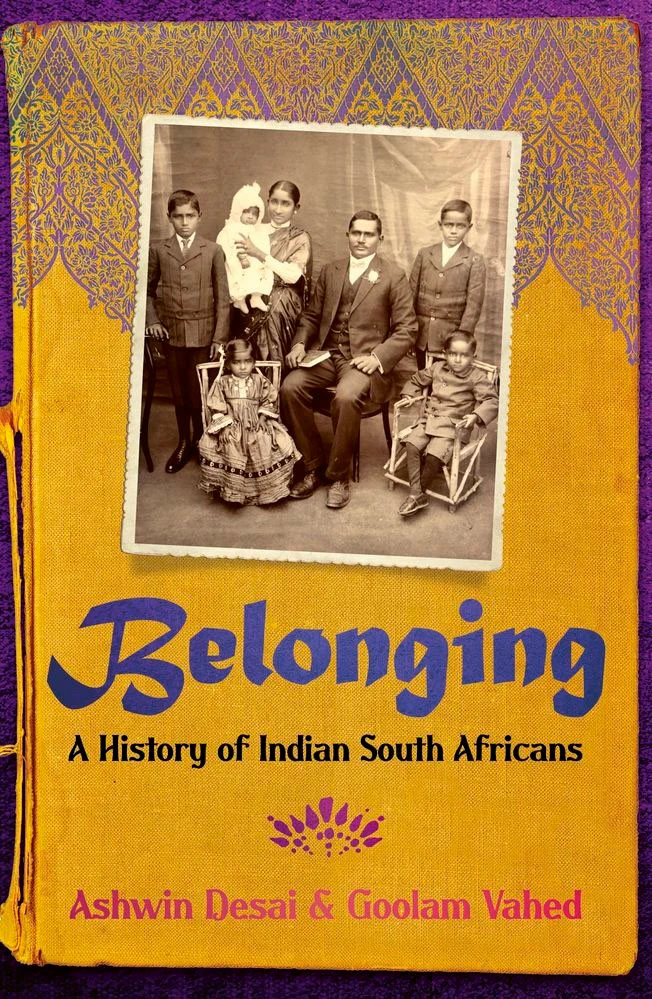 Ashwin Desai and Goolam Vahed, Belonging: A History of Indian South Africans (Johannesburg: Jonathan Ball, 2025)
THE SMALLEST of South Africa’s four ethnic groups as defined by colonial, apartheid and now post-apartheid authorities, the Indian community is the only one whose very survival was constantly threatened. Yet today it plays an influential role in economy and society; a tribute to tenacity and an ability to plan for the future. This has required flattening differences of religion, language and caste, although Ashwin Desai and Goolam Vahed emphasise that this has not been seamless and South Africa’s Indian community is replete with ambiguity and paradox.
Between November 1860 and July 1911, 384 voyages delivered 152 266 indentured Indian labourers to South Africa across what they called the kala pani, most of them young single men. Just over half worked on sugar farms, but tea and wattle farming and the mines also used indentured labour. Most workers quickly lost contact with their roots, opting not to return. Large numbers gained access to land, cleared it and established themselves as market gardeners and hawkers; gradually building up capital.
Others arrived from India as passengers, including some of the previously indentured. As a group they are less well documented but included artisans, traders and some professionals. In general, they were shrewd business people prepared to work long hours with low overheads; a competitive formula. And as free subjects of the Queen Empress they began to shrug off the servility expected by whites from Sammy and Mary. It did not take long to dawn on the second-rate white settlers of Natal that their privileged lifestyle was under threat from stiff economic competition.
The Indian as alien became the accepted norm with demands for repatriation. After 1893 with the grant of responsible government to Natal, increasingly discriminatory legislation was introduced: a poll tax, literacy tests and harsh licensing laws. Abusive language was publicly aired and baying mobs of white thugs occupied the streets. The paradox was the claim that Indians were backward and uncivilised; the reality that they were too competitive. This has a particularly modern ring to it.
Indians supported and served the British in the second South African War as they would later do in both world wars. But self-identification as citizens of the empire, loyalty to the Crown and enthusiasm for the concept of imperial brotherhood cut little ice in South Africa. However, with the move of the struggle for civil rights to the Transvaal, a number of new factors come into play: British expedience; slowly growing influence from India and the figure of Mohandas Gandhi; and increasing numbers of colonial-born Indians some of them well educated.
The tussle between Jan Smuts and Gandhi is well known. Following the march into the Transvaal, numerous and repeated arrests and a general strike involving violence, concessions were made. No basic rights were conferred, but out of this experience Gandhi developed the potential of satyagraha. And as Desai and Vahed note, in South Africa there had already developed a common Indian identity largely absent from the homeland.
Gandhi left South Africa at the outset of World War I never to return. The involvement of an Indian corps serving under Smuts in East Africa had no lasting benefit. There was, for instance, no public memorial in Durban. From the Transvaal, traders led by the ultra-racist Abe Bailey broadcast familiar toxic propaganda and described Natal as an Indian reserve. The Lange Commission of 1921 declared mass repatriation a non-starter as over 50% of Indian South Africans had now been born locally. This did not stem the outrage or invective; another contemporary echo. By way of reaction the South African Indian Congress was formed to assert British identity and link with Congress in India.
Whites feared stiff competition from people they described as a ‘menace’. But they were up against an increasingly assertive and influential lobby in India itself with a wide diaspora. In 1924 South Africa was visited by the charismatic Sarojini Naidu. Against the tide of anti-Indian measures in local affairs, the national Pact government in 1927 signed the Cape Town Agreement, which de facto accepted Indians as a permanent part of the population, establishing a trade-off between socio-economic upliftment and repatriation. With Srinivasa Sastri as the first Indian agent-general, in effect ambassador, upliftment flourished. Indo-European councils were established, social welfare organisations started and education boosted, not least Sastri College in Durban.
Upliftment trumped repatriation, which ended officially only in 1975 after Indians had achieved full citizenship in 1961. The international move towards justice and racial equality remained a threat to whites and their ‘rampant’ Afrikaner nationalism alongside the ‘racial vindictiveness’ of British settlers. The 1930s and 1940s were decades in which calls for repatriation remained loud and many Indians grew increasingly poor because of discrimination. Others flourished as professionals while trade unions fought for Indian workers. During and after World War II there was continuing anti-Indian hysteria focusing on penetration or the move of upwardly mobile people into white suburbs. Yet again facile, prejudicial generalisation failed to be swayed by stark fact and by 1946 the outcome was the Ghetto Act, a dress rehearsal for apartheid, and tighter occupational and movement restrictions.
However, there were significant consequences. Many Indians through the Anti-Segregation Council made a leftward turn towards broad front politics after the Doctors’ Pact (Natal Indian Congress or NIC, ANC and Communist Party of South Africa); passive resistance; and the role of an assertive India at the United Nations arguing convincingly that the position of Indian South Africans was not simply a domestic matter. But following the National Party election victory of 1948 the prospect of apartheid loomed and Indians were a prime target.
In January 1948 the Durban riots erupted with death, destruction and 45 000 refugees. Africans had undoubted grievances against Indians, but there was a lack of action on the part of the authorities and inflammatory statements by whites. In spite of this calamity, a significant alliance developed between Albert Luthuli and Monty Naicker of the NIC. In 1952, the Defiance Campaign, supported in principle by India, enhanced the position of non-racialism and a politics of hope that resulted in the Congress of the People and the Freedom Charter in 1955. The outcome was the following year’s Treason Trial that brought together a virtual parliament of anti-apartheid leaders. In the meantime, Luthuli had received the Nobel peace prize through his advocacy of a non-racial liberal democracy.
The Group Areas Act, finally implemented in the 1960s, had a devastating social and economic impact destroying many communities with 40% of Indians forced to move. Loss of agricultural land led to widespread poverty and there were acute social problems. But the setting up of the Department of Indian Affairs in 1961 had a particularly beneficial effect on education and in 1972 the University of Durban-Westville (UDW) emerged from the tertiary institution on Salisbury Island. With the use of English as a near-universal home language came the emergence of a professional and manufacturing class.
The schism between those prepared to collaborate with the system and the rejectionists was never entirely clear-cut. For instance, from 1967 the town board of Verulam was placed in Indian hands and from this emerged the Reform Party which was a part of the South African Black Alliance. The issue of blackness also arose in the late-1960s out of the Black Consciousness Movement, which had significant numbers of Indian adherents as was shown by the SASO/BPC trial of 1975. The NIC was relaunched, somewhat controversially, in 1971 the year of the murder of detainee Ahmed Timol, and there was vigorous debate about whether to participate in the South African Indian Council. The 1980s saw boycotts at UDW, detention of NIC leaders and the emergence of powerful civic associations such as the Durban Housing Action Committee. Above all there was the United Democratic Front, expressly founded to counter the tricameral parliamentary system. The first House of Delegates election attracted a turnout of less than 20%.
Yet in post-apartheid South Africa the Indian community has continued to face the challenge of a relatively small community confronted by the vigorous nationalism of a politically dominant ethnic group. In 1994, fear outvoted hope and the National Party received strong support from the Indian community. This was not without reason as the song ‘AmaNdiya’ by the racist Mbongeni Ngema showed in 2001. There were also conflicts at the Durban Medical School. Then during the insurrection of 2021, events in Phoenix recalled fraught memories of the 1949 Durban riots. Yet there have been instances of inter-ethnic solidarity: Desai and Vahed go into considerable detail about events in Bayview from 2000. But having mentioned the visit of Narendra Modi in 2016, they say nothing about the reputed growth of Hindu nationalism. Overall, members of the Indian community have migrated out of KwaZulu-Natal filling a wide variety of professional and technical jobs formerly held by whites.
A few minor quibbles. Having correctly described the UDF as sympathetic to ANC ideals (p. 253; not its internal wing) the authors then state it was banned (p. 256; it was restricted and most of its leadership detained). And Yusuf Dadoo’s grave is nearby, not next to, Karl Marx’s in Highgate Cemetery, north London (p. 262). But this is basically a well-told political history leavened by the stories of significant individuals that will appeal to a wide readership. The golfing career of Papwa Sewgolum is particularly poignant with the two-faced Gary Player vainly questioning his card as Sewgolum wins the 1965 Natal Open. Then there is M.L. Sultan, the indentured labourer who in the late 1940s was able to kickstart technical education in Durban.
The insertion of personal histories encourages close reading. But the survival and achievements of the South African Indian community have in large measure been powered by community cohesion and achieved through civil society. However, there is relatively little said about religious, educational, sport, charitable and civic organisations. Does this reflect the authors’ confession about the difficulties faced by historians and sociologists working together?
Book review by Christopher Merrett, reproduced from his web page, From the Thornveld