
Your PhD is Your Gateway to Publishing!
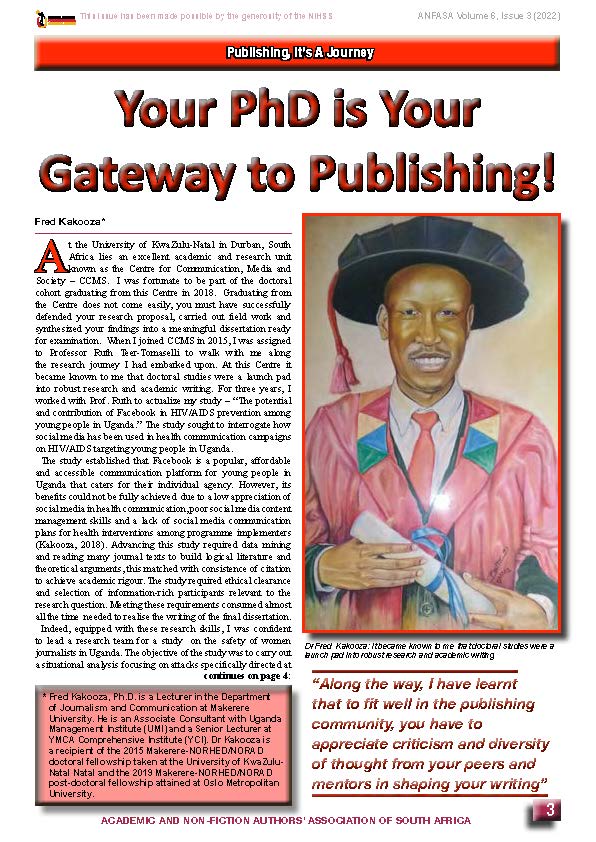 At the University of KwaZulu-Natal in Durban, South Africa lies an excellent academic and research unit known as the Centre for Communication, Media and Society – CCMS. I was fortunate to be part of the doctoral cohort graduating from this Centre in 2018. Graduating from the Centre does not come easily, you must have successfully defended your research proposal, carried out field work and synthesized your findings into a meaningful dissertation ready for examination. When I joined CCMS in 2015, I was assigned to Professor Ruth Teer-Tomaselli to walk with me along the research journey I had embarked upon. At this Centre it became known to me that doctoral studies were a launch pad into robust research and academic writing. For three years, I worked with Prof. Ruth to actualize my study – “The potential and contribution of Facebook in HIV/AIDS prevention among young people in Uganda.” The study sought to interrogate how social media has been used in health communication campaigns on HIV/AIDS targeting young people in Uganda. The study established that Facebook is a popular, affordable and accessible communication platform for young people in Uganda that caters for their individual agency. However, its benefits could not be fully achieved due to a low appreciation of social media in health communication, poor social media content management skills and a lack of social media communication plans for health interventions among programme implementers (Kakooza, 2018). Advancing this study required data mining and reading many journal texts to build logical literature and theoretical arguments, this matched with consistence of citation to achieve academic rigour. The study required ethical clearance and selection of information-rich participants relevant to the research question. Meeting these requirements consumed almost all the time needed to realise the writing of the final dissertation. Indeed, equipped with these research skills, I was confident to lead a research team for a study on the safety of women journalists in Uganda.
The objective of the study was to carry out a situational analysis focusing on attacks specifically directed at women journalists given that many of these occur because of the gender issues involved. The study highlighted the abuses, violations and safety risks encountered by female journalists in Uganda as they go about their work. The process of having an article published from this study was as challenging as the PhD journey itself but a little more hectic since all the research activities that I did in three years were now collapsed to a couple of months – you need to have data that adequately speaks to your research question within a short time (but we had been told at CCMS that yes, the PhD is the gateway to publishing). The first draft was returned with many comments! This was quite frightening; it was akin to receiving examiners’ comments. I asked myself, do reviewers act as examiners? Do I have to go through this for just a publication? If you are faint-hearted, this can be off-putting and your journey may end there.
The final draft was a result of a back and forth activity between the reviewers and the editor. I appreciated that research contributes to a body of knowledge and that within this space, there is need to accommodate divergent viewpoints and suggestions that are aimed at refining your publication. I also realised that journals have publishing standards that need to be adhered to. This is what gives them credibility and a unique identity. It is from this study that my first journal article titled: ‘Female journalists: Negotiating safety and security risks in the Ugandan media environment’ was published (Kakooza et.al., 2020). And it was gratifying to see it in print. This gave me courage to continue with the publishing journey. The second article on Social Media and Health organisations focused on understanding opportunities and constraints using social media platforms in communicating health issues that can potentially improve health outcomes through augmenting not just access to health information but care as well.
The findings showed that among others, Facebook provides opportunity for multimedia communication and specific targeting for health messages. Its potential for health communication is however, constrained by financial, structural and technological limitations prevailing in particular areas. For this article, I received the reviewers comments with ease. It seemed easier to work on this second article that was co-authored with a colleague. The article was published by the journal of Health and New Media Research (Nakiwala & Kakooza, 2020). Along the way, I have learned that to fit well in the publishing community, you have to appreciate criticism and diversity of thought from your peers and mentors in shaping your writing. I am now gaining ground in publishing, I have worked on a book chapter on ‘Social media and HIV/AIDS prevention in Uganda’ which has been published by the Makerere University Press in a book entitled HIV/AIDS in Uganda: Achievements and Challenges edited by James James Kiwanuka-Tondo. I have also co-authored another book chapter titled: ‘Commercial radio news coverage of COVID-19 in Uganda: A case study of Central Broadcasting Service (CBS) radio’ that will be published by Emerald later in the year. I must say that articles can be rejected as well. It is not a given that every time you submit an article it is going to be accepted. I have so far received two rejections! However, this does not mean that your article is unworthy, but rather that the content might not have been appropriate for that edition. This presents an opportunity to rework your article based on the reviewer’s comments and make a submission to another relevant journal or publication. The big lesson here is that publishing requires a considerable time investment for quality texts. It is also good to establish contact with colleagues with whom you can co-author to avoid getting burned out. Importantly, publishing is a thought process that requires patience and appreciation of reviewers’ comments and suggestions if one is to successfully walk the publishing journey. You should not stop, just keep moving and publish.
Fred Kakooza
Full list of References appear in published article for download below.
Click here to download