
The Road to Unity: The Lutheran Churches of Southern Africa Confronting a Divided Past
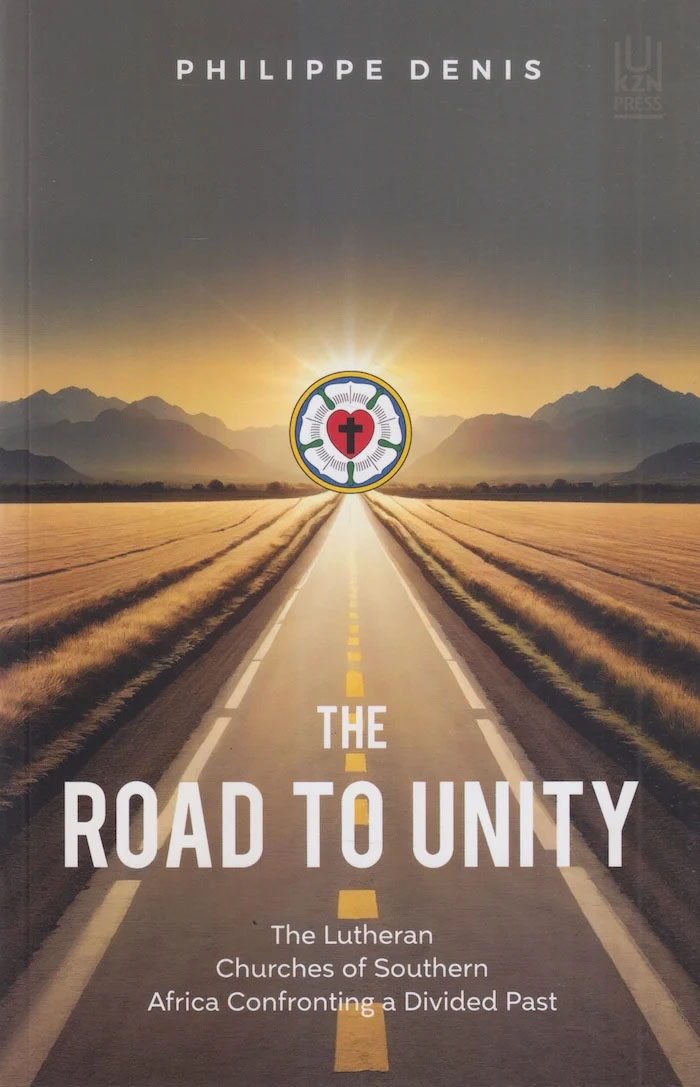 Philippe Denis, The Road to Unity: The Lutheran Churches of Southern Africa Confronting a Divided Past (Pietermaritzburg: Cluster Publications, 2026)
PIETERMARITZBURG could have been the pre-eminent South African centre for theological studies. St Joseph’s Theological Institute dates from 1943 and was joined by FEDSEM (Federal Theological Seminary) in the mid-1970s. The latter collapsed, in part for political reasons, but the Methodists would later set up Seth Mokitimi Seminary, joining as a near neighbour the Lutheran Theological Institute (LTI). LTI had its origins in the city’s anti-apartheid history.
Gunther Wittenberg arrived in Pietermaritzburg in 1973 as a university lecturer in biblical studies and five years later the Lutherans bought a house next to the campus. In the early eighties, largely at the instigation of Wittenberg and in breach of group areas legislation, this became a non-racial Lutheran student residence. With an adjacent property, the Lutheran House of Studies was formed. This was a success with up to fifty students a year and became the LTI. A promising and forward-looking development, this already possessed the seeds of its destruction twelve years later.
First, it involved closure of two other training centres; most notably at Umphumulo, which was controversial, badly managed and accompanied by questions about the suitability of university education for pastoral training. (Ironically, Umphumulo may now be revived.) Second, white student numbers declined to the point where non-racialism disappeared. Third, the curriculum failed to adapt to the varied background of students; and fourth, the successful relationship with the university began to falter. Now the University of KwaZulu-Natal, driven by cynical managerialism and a Durban agenda, it treated the LTI with ‘apathy and disdain’. Fifth, the haphazard way in which the LTI’s extensive property in Scottsville had been acquired left considerable doubt about its current ownership between parts of the Lutheran Church in spite of the existence of an overarching trust. This long-running saga was never entirely resolved and in 2015 became irrelevant. Fundamental governance weaknesses plus a growing financial crisis came to a head with the disappearance of R40 million. No one has ever been held responsible or prosecuted for fraud and today there is literally no trace of the LTI. As a symbol of hoped-for unity within the Lutheran Church its loss had a significance wider than Pietermaritzburg.
The Lutherans arrived in South Africa in the eighteenth century and their long history became a stew of acronyms. This is perhaps best understood as a division between two heritages: settler and missionary from Germany, Scandinavia and the USA. There are also the Moravians and various breakaway groups, but these are not considered in Philippe Denis’s book. The Lutherans remain divided to this day, although both main traditions are mixed up to a point. There is no overarching authority as in the Roman Catholic, Anglican and Methodist churches, much governance is congregational and where there are bishops, they are often conveners as much as leaders.
The mission culture was based on discipline and obedience; and conversion of groups rather than individuals. Missionaries were paternalistic employers and their converts labourers on peasant farms. There was in this approach a predisposition to segregation later formalised as separate development; and it is no coincidence that one of the architects of apartheid was W.W.M. Eiselen, son of a Botshabelo missionary. The Lutherans were very slow to ordain black ministers, one of the reasons for breakaways.
The move towards a church structure started in Natal with the development of synods or voluntary congregational unions; logical since in the nineteenth century the colony had the greatest number of missions. CLM (Co-operating Lutheran Missions) was founded in 1912 by the Umphumulo, Emaus and Oscarsberg communities. The Christianenburg Assembly at New Germany in 1958 basically endorsed an ethnic federation, essentially a mirror to apartheid; but in 1964 four regional churches emerged from the mission synods.
The settler heritage congregations reacted similarly, although more in the form of a federation. FELCSA (Federation of Evangelical Lutheran Churches in Southern Africa) founded in 1966 achieved some acceptance of sharing and promoted the Swakopmund Appeal of 1975, but failed to achieve a merger. That year the mission churches did just this through ELCSA (Evangelical Lutheran Church in Southern Africa) in defiance of apartheid; but many white Lutheran congregations supported apartheid overtly, or covertly by pleading cultural identity and differences in governance.
Lutherans long struggled with the doctrine of separation of church and politics. They capitulated for instance to the Bantu Education Act of 1953 by removing the Oscarsberg training centre to Umphumulo; while by way of contrast other Protestant churches eventually set up FEDSEM. There was also passivity regarding the forced relocation of black congregations with the one exception of Helge Fosseus of the Swedish mission at Rorke’s Drift in 1962. But Lutherans deftly managed to sit on the fence, sympathising with victims but offering no resistance. At Mogopa in the mid-1980s this was left to other denominations and the Black Sash. In South West Africa it was a very different story with active opposition to the Odendaal Plan of the 1960s.
But in 1967 the Umphumulo Memorandum was adopted. Based largely on the input of Wolfram Kistner, who would for a while be a colleague of Wittenberg’s in Pietermaritzburg, he argued that there was nothing in the teaching of Martin Luther that totally separated the spiritual and the political. The memorandum rejected apartheid but caused polarisation; and when it was adopted by the Swakopmund Appeal it was not binding. From the mid-1970s the Lutheran World Federation (LWF) Department of Mission gave increasing support to the anti-apartheid cause. Manas Buthelezi labelled racism a heresy for placing fear of one’s neighbour above a love of God.
Events in Venda in 1981 and 1982 exacerbated the situation when a number of Lutheran notables including Tshenuwani Farisani were detained and tortured. One of them, Tshifhiwa Muofhe, an elder, died. White Lutheran churches issued empty phrases and it was no secret that among security branch torturers were Lutherans. A warning had already been issued at the LWF general assembly at Dar es Salaam in 1977 and seven years later in Budapest the white churches were suspended. This, instead of expulsion, was enforced as the result of a fraternal plea by the black Lutherans. White Lutherans were generally enraged by what they saw as political interference, portraying themselves as victims in a fashion that echoes loudly today.
There were Lutherans involved in the anti-apartheid struggle but they were scattered with few high-profile figures among them; no one of the stature of Desmond Tutu, Dennis Hurley or Peter Storey. The number did increase under the influences of black consciousness and black theology. Manas Buthelezi, who served in Sobantu and was Natal director of the Christian Institute was banned for five years in 1973, but this was prematurely lifted. He became a bishop and president of the South African Council of Churches (SACC) from 1983 to 1990 and successfully sued the right-wing journalist and Baptist minister John Poorter along the way. Sibusiso Ndebele was active in SASO (South African Students Organisation) and the UCM (University Christian Movement). These were active under the radar at Umphumulo and influential. Farisani had been constantly harassed by the security branch since his original detention in Pietermaritzburg and Howick in 1977; Kistner worked for the SACC; while Molefe Tsele was at the Institute for Contextual Theology, successor to the banned Christian Institute, and detained and charged a number of times.
The Kairos Document of 1985 was a stimulus for the Lutheran Confessing Fellowship which advocated active support for apartheid’s victims and condemnation of those who supported state oppression. But it was swiftly crushed, not least by Buthelezi. Effective activism was seen as a challenge to power within the Lutheran Church, which drew much of its strength not just from conservative whites but the rural bantustans particularly Bophuthatswana, Venda and even KwaZulu (Buthelezi was a half-brother of the chief minister Mangosuthu). Not all black Lutherans opposed apartheid. And among white Lutherans there were supporters of the right-wing Gospel Defence League and various fringe groups in the Natal Midlands from the 1970s. The Lutheran Church made no input to the Truth and Reconciliation Commission although there were subsequent statements of regret. And more recently there has been land restitution in the Vryheid and Marburg areas.
The shock of suspension from the LWF jolted the newly constituted Unity Commission into action and there was in the mid-1980s a commitment to talks without precondition. German church influence on the commission’s deliberations was measured and reasonable, but by the time they petered out in 1995 a number of obstacles remained. These were salary disparities, the terms of office of bishops, and the rights and duties of congregations as juristic persons. A draft unity constitution was available from 1991; but after liberation while the white churches sought unity more convincingly, their black counterparts no longer saw it as a top priority. Reading between the lines it seems that material issues such as salaries and property ownership were obstacles plus the practical matter, and its symbolism, of the collapse of the LTI. And unity as an act of defiance against the state system was no longer important. Another attempt at negotiations was made in 2008, but again the can was kicked down the road.
Further unity attempts have been ongoing since 2022 and Denis hopes that his measured and thorough history of the Lutheran Church as an outsider (he is a Dominican and a well-regarded church historian) will assist. He writes, convincingly, of the burden of the past while pointing out that other churches have, at least structurally, overcome it. But he does not mention the burden of the present. This is the growing power of fundamentalists within all religions, not least the Christian, to build walls that have no regard for dissimilar neighbours while broadcasting an aggressive belief in their almighties.
If the Lutheran Church can achieve unity, it will now be rowing against a strong current tide.
Book review by Christopher Merrett, reproduced from his web page, From the Thornveld