
Book reviewing is a measurable output
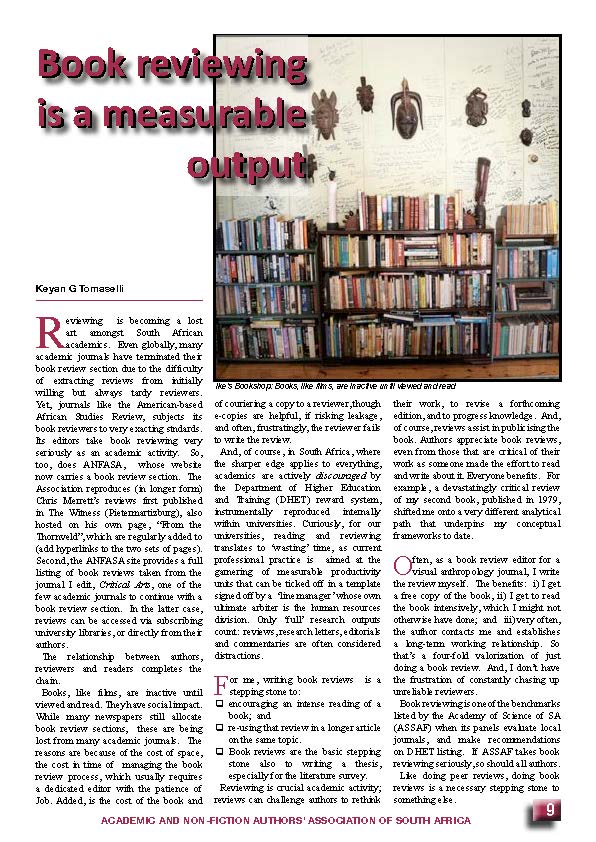 Reviewing is becoming a lost art amongst South African academics. Even globally, many academic journals have terminated their book review section due to the difficulty of extracting reviews from initially willing but always tardy reviewers. Yet, journals like the American-based African Studies Review, subjects its book reviewers to very exacting standards. Its editors take book reviewing very seriously as an academic activity. So, too, does ANFASA, whose website now carries a book review section. The Association reproduces (in longer form) Chris Merrett’s reviews first published in The Witness (Pietermartizburg), also hosted on his own page, “From the Thornveld”, which are regularly added to (add hyperlinks to the two sets of pages). Second, the ANFASA site provides a full listing of book reviews taken from the journal I edit, Critical Arts, one of the few academic journals to continue with a book review section. In the latter case, reviews can be accessed via subscribing university libraries, or directly from their authors. The relationship between authors, reviewers and readers completes the chain. Books, like films, are inactive until viewed and read. They have social impact. While many newspapers still allocate book review sections, these are being lost from many academic journals. The reasons are because of the cost of space, the cost in time of managing the book review process, which usually requires a dedicated editor with the patience of Job. Added, is the cost of the book and of couriering a copy to a reviewer, though e-copies are helpful, if risking leakage, and often, frustratingly, the reviewer fails to write the review. And, of course, in South Africa, where the sharper edge applies to everything, academics are actively discouraged by the Department of Higher Education and Training (DHET) reward system, instrumentally reproduced internally within universities. Curiously, for our universities, reading and reviewing translates to ‘wasting’ time, as current professional practice is aimed at the garnering of measurable productivity units that can be ticked off in a template signed off by a ‘line manager’ whose own ultimate arbiter is the human resources division. Only ‘full’ research outputs count: reviews, research letters, editorials and commentaries are often considered distractions.
For me, writing book reviews is a stepping stone to encouraging an intense reading of a book; and re-using that review in a longer article on the same topic. Book reviews are the basic stepping stone also to writing a thesis, especially for the literature survey. Reviewing is crucial academic activity; reviews can challenge authors to rethink their work, to revise a forthcoming edition, and to progress knowledge. And, of course, reviews assist in publicising the book. Authors appreciate book reviews, even from those that are critical of their work as someone made the effort to read and write about it. Everyone benefits. For example, a devastatingly critical review of my second book, published in 1979, shifted me onto a very different analytical path that underpins my conceptual frameworks to date.
Often, as a book review editor for a visual anthropology journal, I write the review myself. The benefits: i) I get a free copy of the book, ii) I get to read the book intensively, which I might not otherwise have done; and iii) very often, the author contacts me and establishes a long-term working relationship. So that’s a four-fold valorization of just doing a book review. And, I don’t have the frustration of constantly chasing up unreliable reviewers. Book reviewing is one of the benchmarks listed by the Academy of Science of SA (ASSAF) when its panels evaluate local journals and make recommendations on DHET listing. If ASSAF takes book reviewing seriously, so should all authors. Like doing peer reviews, doing book reviews is a necessary stepping stone to something else.
Click here to download article.
Keyan G Tomaselli