
The Dark Prince
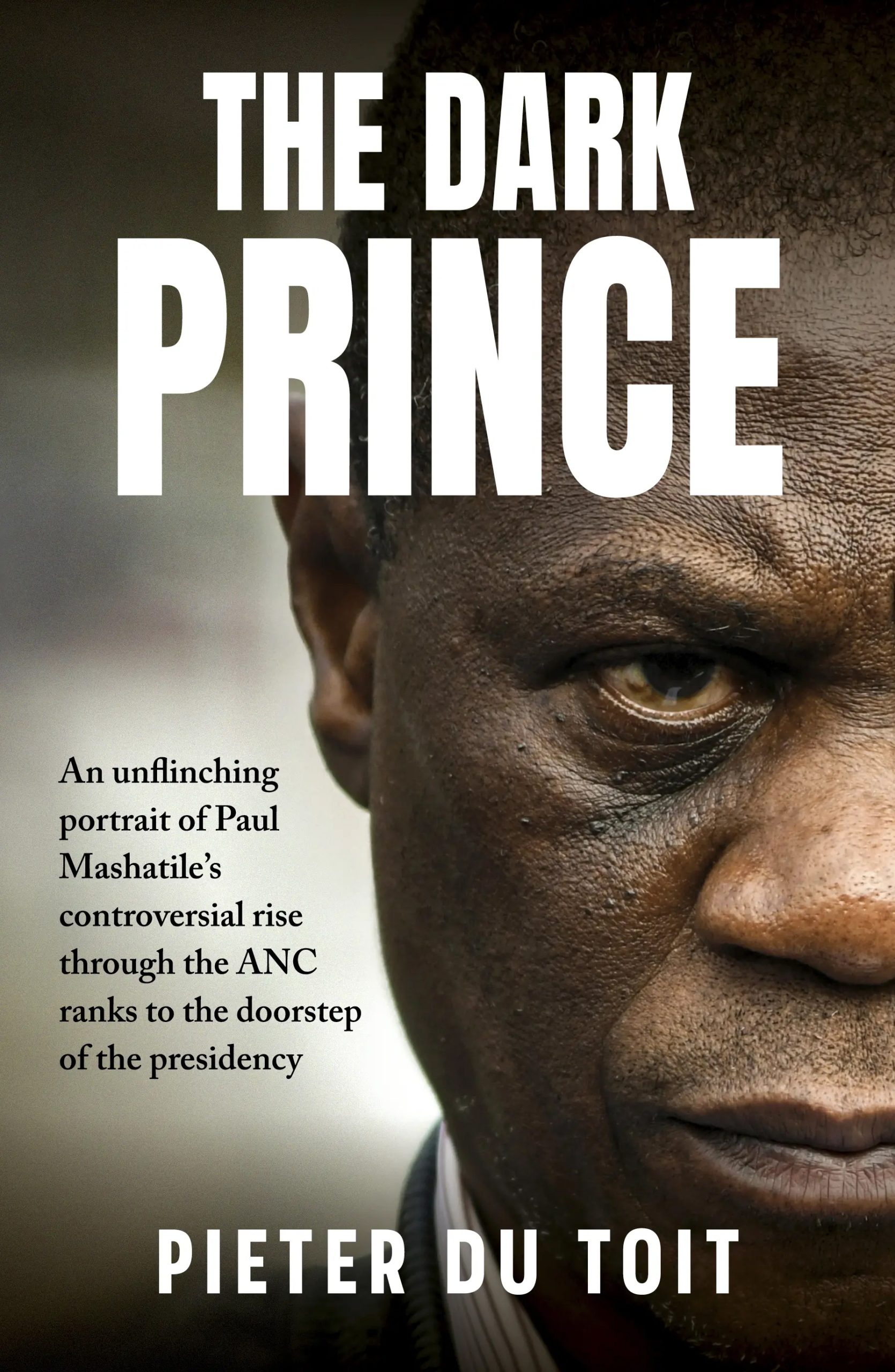 Pieter du Toit, The Dark Prince (Johannesburg: Jonathan Ball, 2025)
WITH regularity the citizens of Midrand are put in peril by blue-light convoys driving against the flow of traffic, forcing motorists off the road and creating hold-ups. VIP corridors are created by heavily armed men acting on behalf of vice-president Paul Mashatile.
Pieter du Toit calls him the Dark Prince, appropriate enough for a career politician who had a relatively low national profile before the presidency of Cyril Ramaphosa. Now he is in a position to challenge for the ANC’s top spot in 2027 and possibly become national president. Du Toit fears that based on evidence of his political conduct and personal character he could be another Jacob Zuma.
Born in 1960, Mashatile grew up in Atteridgeville and was educated in Alexandra where he was a member of COSAS and the youth congress, AYCO. Detained in July 1985, possibly in relation to the bus boycott, he was apparently held for nearly four years. In Diepkloof prison he joined the detainees’ hunger strike and was released in April 1989 under restriction. His roots in AYCO and support from a handful of close associates now known as the Alex Mafia enabled and shaped his career. Until 2010 he was also a member of the SACP.
During the transition period before the first democratic elections, he made himself useful in a variety of ways and in 1994 he became a member of the Gauteng provincial legislature. Two years later he was MEC for Transport, followed by a spell at Safety and Security then five years at Housing until 2004. While Gauteng received 43% of national funding, it delivered only 24% of the total units. Of particular note was the failure of the Alexandra Renewal Project, a potentially transformative initiative to build a new city that Mashatile might have been expected to champion vigorously. Instead, it was a failure foundering on mismanagement, particularly financial.
Mashatile was to become Finance MEC during a period when the interests of the ANC and its officials and business allies and donors became increasingly blurred to the detriment of good governance. For the first democratic decade a pattern was set: Mashatile was able to navigate his way skilfully through the factional ANC politics of Gauteng while achieving nothing noteworthy in office; yet enjoying a lavish lifestyle at taxpayers’ expense. In the background were the enablers of the Alex Mafia.
With the fall of Thabo Mbeki and rise of Zuma, Mashatile fell from grace although for a brief seven months he was Gauteng premier. There was nothing ideological about this sidelining; simply a clash of rent-seeking factions. Zuma exiled Mashatile to the national Department of Arts and Culture which Du Toit describes as the gulag of government. Here, and later as chair of the parliamentary standing committee on appropriations, he made minimal impact. But crucially he maintained his power base in Gauteng.
Nifty footwork, an eye for the main chance and an ability to play the long game are Mashatile’s main attributes. So at Mangaung in 2012 he campaigned on an anti-corruption slate aware that the ANC was losing ground in particular in Gauteng because of e-tolls, the Nkandla scandal and growing awareness of state capture. This campaign failed but at Nasrec five years later he backed Ramphosa’s CR17 bid against the RET (radical economic transformation) faction and became ANC treasurer-general. The top six were a divided group but an expulsion and a death eased his path towards the vice-presidency of party and then country in 2022 and 2023.
Zuma was quickly unseated after the 2017 elective conference, but Du Toit justifiably describes the effect as a mirage. The Zondo Commission uncovered a cesspit of corruption and misgovernance but there has been no meaningful follow through. Indeed, real change would require the dismantling of the ANC. One of Mashatile’s regular benefactors, Edward Sodi of Blackhead Consulting, was investigated by Zondo but Mashatile remained untouched. However, he was now firmly in the media spotlight.
His first three decades in politics were characterised by underperformance, persistent criticism from auditors and a lavish lifestyle involving conspicuous expenditure on food and drink and hospitality from the very rich. His career was always a step or two distant from questionable deals; a kept politician in the Zuma tradition.
Now it was revealed that Mashatile had beneficial ownership of two massively expensive properties in Waterfall and Constantia courtesy of his son-in-law, although the source of the latter’s wealth was obscure. Mashatile also had a number of mistresses (his wife died in 2020) and there is evidence that at least one was subsidised by businessmen. The lavish spending on entertainment has continued. Through his second marriage he now appears to have links to the national lottery. Mashatile’s personal needs are funded by ANC donors and government contract beneficiaries through cash payments and under the protective umbrella of the deep, longstanding ties of the Alex Mafia. But theoretically this also makes him potentially vulnerable.
In spite of the myth that ANC leaders arise organically from the broad movement, vigorous campaigning and plentiful cash drive the process. Mashatile’s campaign for 2027 is well advanced under the slogan iThemba Lethu (Our Hope) interspersed with spurious memorial lectures. There has also, à la Trump, been a supposed assassination attempt. The quintessential party functionary, his speeches consist of formulaic entries from the ANC phrase book, simplistic repetitive responses and vapid generalisations in Du Toit’s opinion. There is little sign of what Mashatile believes in, if anything apart from the acquisition and retention of political power and personal wealth.
His role and profile have been enhanced by the existence of a coalition government, but he has little regard for the DA and sees MK and the EFFs as natural allies. This is logical given their affinity for corruption. In the author’s view, Mashatile has generally been little more than a name on an ANC organogram for decades; yet he is a master of patronage. This is unsurprising for an organisation dedicated to extraction and pageantry above service and delivery; effectively a state within a state in Leninist style. Mashatile’s probity, judgement, competence and seriousness are all debatable and all sacrificed to his own interests. This has been shown vividly by Du Toit, but how different is Mashatile from the average ANC politician?
This is not biography – there is far too little to say about Mashatile the party careerist to warrant one – but an assessment of his fitness for the presidency. Even so, Du Toit pads out the book with historical background admitting that he enlisted AI in this task. Why this is necessary when there is a selection of authoritative books to provide the author’s needs is a sign of the times. But it may explain the error in the date of the foundation of the PAC: 6 April 1959; not March 1960.
This book’s verdict is that Mashatile is the last man standing in a predator party and state representing the ‘darkest impulses of the ANC.’ It seems he would have no qualms in creating alliances with parties that would trash the Constitution in pursuit of profit from the State; at which he is adept. It could be that the Zuma era was no anomaly but a first episode of state capture that Mashatile will develop yet further.
Book review by Christopher Merrett, reproduced from his web page, From the Thornveld