
A Roving Eye: Selected Essays
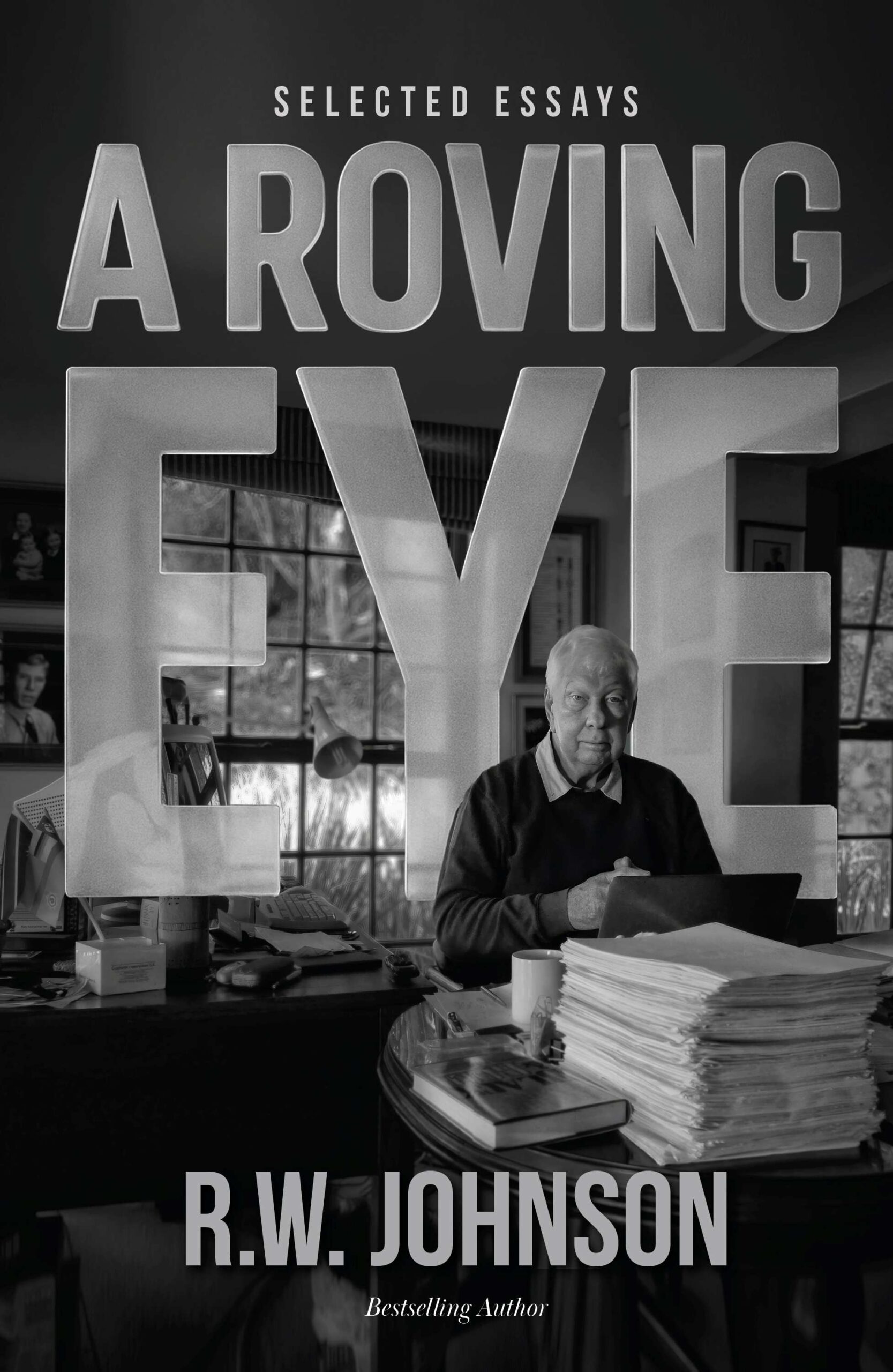 R.W. Johnson, A Roving Eye: Selected Essays (Johannesburg: Tracey McDonald, 2026)
THE FORTY topics covered in this book have been chosen from Bill Johnson’s weekly contributions since 2022 to the digital publication BizNews edited by Alec Hogg. As Johnson observes, the ability to keep on doing this depends on originality of information or ideas. He is famous for a willingness to challenge fashionable progressive opinion; and to the irritation of critics, often proved correct.
Charles van Onselen in his foreword links Johnson’s ability to his teaching of Modern Greats (politics, philosophy and economics, PPE) at Oxford University. The purpose of PPE is to diminish disciplinary silos in the interests of a bigger picture; something consistently reflected in Johnson’s journalism. This book’s publicist promotes it as written in the spirit of George Orwell.
Weekly columns are not easily blended into a book. These contributions are divided into four sections: people, South Africa, international affairs, and miscellaneous. The best way to review the book seems to be to emulate Johnson: join the dots and extract broader views.
In deploring a decline in political leadership worldwide he identifies the loss of deep literacy. No one exemplifies this better than Donald Trump, a deranged convict and a ruthless property developer who understands the price of everything, but the value of nothing except self-interest. Johnson cautions against a fixation on Trump, who will soon be gone, and warns about the sinister and much younger forces behind him. Turning to the tech trillionaire Elon Musk and his ilk, Johnson exposes personal flaws such as narcissism and childishness, but says little about their extreme right-wing sympathies.
He seems upbeat about the future of democracy based on the facts that university education and female participation in public life are increasingly widespread. There is indeed evidence for this in certain places, although he does not mention worrying polls from western Europe, including Britain, suggesting that a significant proportion of young people have bought into support for the benign dictator syndrome. And many brands of university education do not broaden minds in the fashion of PPE.
Johnson is at his best when he writes on South Africa. He was absolutely right about the nature of liberation movements even those that negotiated a transition. While this was widely recognised there was a misplaced optimism that South Africa could, and would, prove an exception. The public relations approach of Nelson Mandela brought brief encouragement; while obscuring the soviet legacy that the ANC exiles imported and the rampant opportunism that took hold.
Analysis of the assassination of Chris Hani is perhaps the highlight of this collection. Conspiracy theory can be tiresome, but it is always worth asking: cui bono? Thabo Mbeki has been fingered by many but the motives of accusers have been dubious. Johnson too considers Mbeki but makes out a far more serious case for the venal Joe Modise who had every reason to see Hani removed from the frame; the one person who could torpedo Modise’s rackets and arms deal corruption.
In Johnson’s view South Africa’s three elected presidents since Mandela have been a sorry bunch. There is now no one in the ranks of a shrinking ANC who could improve upon an underwhelming Cyril Ramaphosa. The astonishing suggestion is made that Thabo Mbeki should return. Not only did he alienate his party and create a coalition of the disaffected that led to the national disaster of Jacob Zuma; but he cynically backed the lawless government of Zimbabwe and denied HRVs to thousands of South Africans dying of AIDS. Today he plays the part of party elder, but there is little reason to suppose that age has improved the chronic lack of judgement based on blind prejudice that led to his previous downfall.
South Africa’s foreign policy, with the exception of a couple of Mandela’s interventions, has been woeful to disastrous since 1994. In the last decade and a half, it has been fashionable to welcome a multipolar world in which South Africa has fancied it would play a significant role, notably through an expanded BRICS. As Johnson points out, multipolarity has ended up as bipolar as ever with a malignant Russia exploiting the gaps. In the new imperial world order the idea of Africa’s century will not thrive and South Africa’s best chance is with a coalition of medium-grade economic powers.
Sympathy for the plight of the Palestinians is one issue; blatant support for the Islamist regime in Tehran and its proxies altogether another. Johnson dwells on the behaviour, links and sympathies of Ebrahim Rassool and Naledi Pandor. And he points out that the department of international relations appears to be run as much in the interests of Iran as South Africa. The latter has unerringly picked the losing side in all senses, practical and moral, as in the case of support for Russia.
One of the concluding chapters is entitled ‘Within living memory’ and for Johnson his first recollection was VJ Day, 11 August 1945. As an undergraduate he met a very old lady whose life-changing experience had been the coming of electricity. His thoughts on historical connectivity are a reminder that without a clear sense of the past we struggle for identity and to move forward. The final chapter is about his support for Liverpool football club preceded by a moving account – ‘Helen’s Farewell’ – of the assisted dying in Switzerland of a younger sister suffering from alpha antitrypsin deficiency and thus terminal emphysema.
Disappointingly, the publisher has not come fully to the party, seemingly skipping those expensive and tedious, but essential, processes of editing and proofreading. The contents were digitally converted and presumably created glitches that surely could not have been in the author’s original writing.
Book review by Christopher Merrett, reproduced from his web page, From the Thornveld